
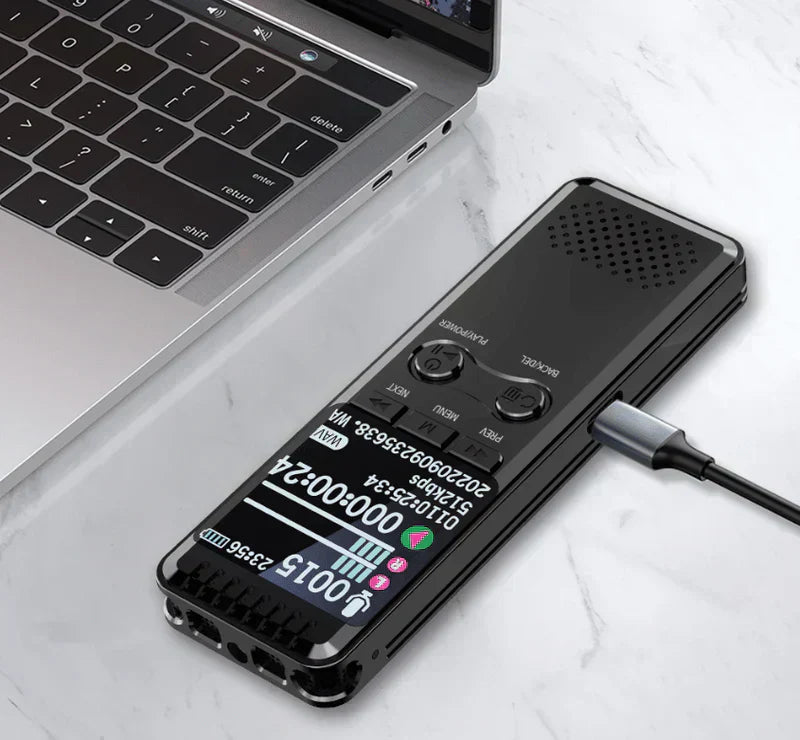
In an era of growing concerns about security and privacy, more and more people are considering using voice recorders. Such devices can help document important conversations, gather evidence in court cases, or simply remember important information. However, many people wonder whether their use is legal and in what situations conversations can be legally recorded. The regulations in this area can be complex, and unknowingly violating the law can lead to serious consequences. In this article, we will explain the regulations regarding call recording, when recording without the interlocutor's consent is allowed, and what to consider when choosing and using voice recorders.
Is recording conversations legal? Legal regulations
In Poland, current regulations allow for the recording of conversations in which we participate without the need to inform the other party. This is confirmed by Article 267 § 3 of the Penal Code, which penalizes only the unauthorized acquisition of information to which one is not entitled, for example, by wiretapping third-party conversations. Recording other people's conversations—that is, conversations in which we are not involved—may violate the right to privacy and be subject to severe legal consequences.
Dictaphones and legal regulations – what is worth knowing?
The possession and sale of voice recorders are legal in Poland, but their use may be subject to restrictions under applicable regulations. The most important issue is the purpose for which conversations are being recorded – if the device is being used legally, for example, to protect one's own interests, there is no cause for concern. The problem arises when the recording violates someone's privacy or is performed without a legitimate legal basis. It is worth remembering that recording audio using hidden equipment cannot be used to obtain information illegally, which could lead to criminal or civil liability.
When can conversations be recorded without consent?
Under Polish law, there are situations in which audio recording is permitted, even if the other party is unaware of it. This primarily applies to cases where the recording person is participating in the conversation and has a legitimate interest, for example, to protect themselves against a dishonest employer, an aggressive contractor, or misrepresentation. Recording law may also apply to cases where the recording constitutes evidence in a court case, although its use may depend on the court's decision. It is worth noting, however, that while recordings may be admissible as evidence in civil proceedings, their use may result in criminal liability for the recording person.
What are the consequences for illegal recordings?
Recording conversations may seem like a simple way to protect one's interests, but if done illegally, it can lead to serious consequences. First and foremost, anyone who illegally records conversations in which they are not involved may be held accountable under privacy laws. According to Article 267 § 3 of the Penal Code, such action can result in a fine, restriction of liberty, or imprisonment for up to two years.
Spying devices, such as hidden voice recorders, used to violate someone's privacy can also result in civil consequences – the injured party has the right to seek compensation for violations of their personal rights and freedom of expression. Furthermore, if the recording is published or used for blackmail, the situation becomes even more complicated, and the person responsible for its dissemination may face criminal charges.
How to choose and use a voice recorder legally?
First and foremost, it's important to remember that owning such a device isn't illegal, but how it's used is. The most important thing is to record conversations legally and respect the privacy of others. When choosing a voice recorder, it's worth choosing models with good sound quality and a long operating time, especially if the recordings will be used for professional purposes or as security in the event of a dispute. To avoid legal issues, it's best to use recordings only for personal use or in situations where the recording could constitute evidence in a case, but making it public would be risky. Before purchasing and using a device, it's also a good idea to familiarize yourself with the regulations regarding recording conversations to avoid unknowingly violating the law.
Frequently asked questions and myths about call recording
Recording conversations evokes a lot of emotions and is often associated with legal uncertainties. Many people wonder whether they can record conversations in the workplace, whether recordings can be used as evidence in court, and what the limits of privacy protection and the law are in this regard. One of the most common myths is that anyone has the right to record any conversations they participate in and share them publicly – in reality, this isn't always legal. Another common misconception is that spying devices, such as voice recorders hidden in everyday objects, can be used without restrictions. In fact, if they violate someone's privacy or are used for illegal activities, they can lead to serious legal consequences. To avoid problems, it's worth using common sense and ensuring that voice recorders are used legally.
Legality of voice recorders – how to use them without breaking the law?
A voice recorder can be a useful tool in both personal and professional life, but it requires knowledge of legal regulations. Illegal recordings can lead to serious legal consequences. Remember that recording laws vary depending on the situation, so it's worth being well prepared.


Leave a comment
This site is protected by hCaptcha and the hCaptcha Privacy Policy and Terms of Service apply.